
A site visit checklist for a measure and quote has three parts. Before you go: confirm the time, the address and who will be there, and read what they told you. On site: walk the job with the homeowner, measure, check access, the ground and services, and find out who decides and what they want to spend. Before you leave: say what happens next and when the quote will arrive.
A lot of what goes wrong on a quote starts at the visit. A missed step, a gate too narrow for the machine, a partner who was not there. The checklist below catches those while you are still standing in the yard.
Before you go
- Confirm the visit the day before. Day, time, address, and ask if everyone who will decide can be there. Ask for a reply.
- Read the enquiry again. What did they ask for, in their words? Any photos, drawings or a budget? Note anything that does not add up.
- Look at the property. A satellite view shows the slope, the trees, the shed in the way and where the street parking is.
- Bring what you need. Tape and laser measure, a level, a camera, a notepad or your phone, sample boards or a brochure for the main options, and something to write a quick sketch on.
- Allow enough time. A rushed visit misses things and often means a second trip. Book the length the job needs, and tell the homeowner how long it will take.
If the enquiry has not been checked yet (suburb, owner, timing, budget), do that on the phone first. How to qualify an enquiry before you quote has the questions. A visit is a few hours of your day, counting the drive.
On site: walk it together
Start by asking them to show you. “Walk me through what you’re thinking” gets you more than a list of questions. Listen for the words they use: the reason behind the job, the date it has to be done by, what they did not like about the last tradie.
Then say back what you heard in a sentence or two. It catches misunderstandings before they become a quote that misses the point.
On site: the job itself
- Measure everything you will price, and photograph it with the tape in shot. Measure twice where it matters.
- Access. Gate widths, side paths, stairs, parking, where a skip or delivery can go, whether a machine or a crane can get in. Narrow access changes the labour.
- The ground. Slope, fill, rock, roots, wet spots, retaining walls. For a build or an extension, whether you need a survey or soil test before you price it. See feature and contour surveys and geotechnical reports.
- Services. Where the power, water, gas, sewer and stormwater run. Before anyone digs, free plans of underground services can be requested through Before You Dig Australia. Check the switchboard if your job adds load.
- What is there now. Old materials to remove, the condition of what you are tying into, anything that might be hazardous in an older house. Note it, photograph it, and price or exclude it in writing.
- Neighbours and boundaries. For fences and decks and anything near a boundary, who shares it, and whether the neighbour knows.
- Approvals. Whether the job is likely to need council or certifier approval. If you are not sure, say you will check and put it in the quote.
On site: who decides and what they want to spend
These two questions feel awkward and save the most time.
- Who decides. “Is anyone else involved in choosing who does the work?” If a partner, a parent or a body corporate has a say and is not there, offer to go through it with them on the phone or come back.
- Budget. “Do you have a figure in mind, so I can tell you if it’s realistic?” If they do not know, give a range for jobs like this and watch the reaction.
- Timing. When do they want it done, and why that date?
- Other quotes. “Are you getting a few prices?” Many are: Consumer Affairs Victoria, for one, tells homeowners to compare at least three quotes for the same plans and specifications. It is useful to know so you can make your quote easy to compare.
- Options. Would they like one price, or two or three options at different levels? Ask while you are there.
Before you leave
The last two minutes of the visit decide whether the homeowner waits for your quote or forgets you.
- Say what happens next. “I’ll work this up and email the quote by Thursday.”
- Give a date and keep it. If you will be late with it, text before the date, not after.
- Say what you still need. Drawings, a colour choice, the neighbour’s name, a survey.
- Book the follow-up. “I’ll ring you Friday to go through it.” Write the date down where you will see it.
- Thank them, and leave the site as you found it. Shut the gate.
The checklist, as a table you can copy
| Stage | Check | Done |
|---|---|---|
| Before | Visit confirmed the day before, reply received | [ ] |
| Before | Everyone who decides asked to be there | [ ] |
| Before | Enquiry, photos and drawings read again | [ ] |
| Before | Property looked at on a map: slope, access, parking | [ ] |
| Before | Tools, samples and notepad packed | [ ] |
| On site | Homeowner walked you through it; you said it back | [ ] |
| On site | Measurements taken and photographed | [ ] |
| On site | Access: gates, paths, parking, delivery, machines | [ ] |
| On site | Ground: slope, fill, rock, roots, drainage | [ ] |
| On site | Services located; dig plans needed? | [ ] |
| On site | Existing work, removal and hazards noted | [ ] |
| On site | Boundaries, neighbours, approvals | [ ] |
| On site | Who decides; were they all there? | [ ] |
| On site | Budget, timing and reason for the date | [ ] |
| On site | One price or options? | [ ] |
| Leaving | Quote date given | [ ] |
| Leaving | What you still need from them listed | [ ] |
| Leaving | Follow-up call booked | [ ] |
After the visit
Write your notes up the same day while you remember the details. Turn the measurements and photos into the quote. A quote that repeats the homeowner’s own words back to them (“the side gate needs to fit the trailer”) shows you listened. How to write a quote a homeowner can say yes to covers the layout, and how to quote a job covers the pricing.
Then send it by the date you gave. If you use the PreBuild app, you enter the date you promised the quote by when you log the visit, and it reminds you to send it (see the app).
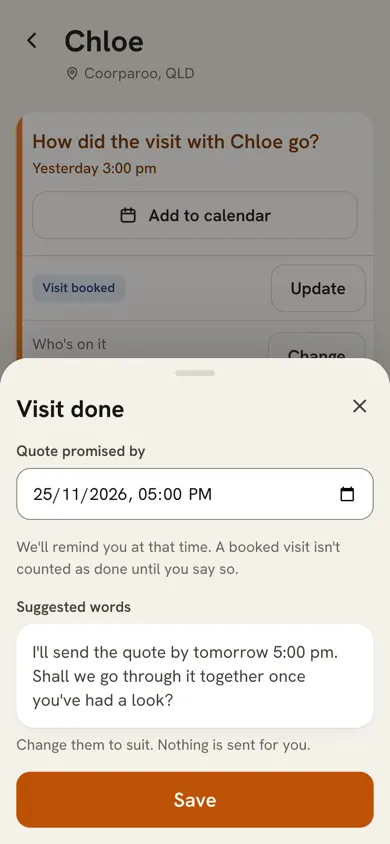
See how the app works
Common questions
What should I check at a site visit?
Measurements, access, the ground, where services run, what is there now and needs removing, boundaries and approvals. Then ask who decides, what they want to spend and when they want it done.
How long should a measure and quote visit take?
As long as the job needs to be measured and talked through properly. Tell the homeowner how long when you book it, so they set aside the time and anyone else who decides can be there.
Should I give a price on site?
Only a range you can stand behind, and say what it covers. For most jobs, say when the written quote will arrive and keep that date.
What if the person who decides is not at the visit?
Offer to go through it with them on the phone, or book a short second visit. Pricing a job for someone who has not seen it or met you often ends in a quote that goes quiet.