
A good voicemail for a homeowner says five things in under 20 seconds: your name and business, the job they asked about, their suburb, one reason to ring back, and one time you will try again. Leave your number twice, slowly. Then send a text straight after with the same details, because many people read a text before they play a message.
The scripts below are for the calls a trade business makes most: a new enquiry, a quote you are chasing, a site visit they missed, and a second try on a new lead. Change the words until they sound like you.
What makes a homeowner ring back
A homeowner who asked for a quote will usually ring back if the message tells them three things quickly: who you are, that you are ringing about their job, and what happens next. Messages that do not get returned tend to be long, vague or sound like a sales call.
- Your name and business, first. “It’s Dave from Northside Fencing” in the first two seconds tells them it is not a cold call.
- The job and the suburb. “About the colorbond fence in Ascot” shows you read the enquiry. A homeowner who sent out a few enquiries can tell you apart from the others.
- One reason to ring back. A question you need answered to price it, or a time you can come out. One reason only.
- One time. “I’ll try you again at 4” gives them a reason to keep the phone near them, and means they do not have to ring you at all if that suits.
- Your number twice. Say it at the end, slowly, in groups: “0412, 345, 678”. Say it again.
Keep it under 20 seconds. Write the script down, say it out loud a few times, and time it on your phone. If it runs over, cut words and keep the details.
Voicemail 1: a new enquiry
This is the first call after an enquiry lands. The aim is to get a conversation. The quote comes later.
Hi [first name], it’s [your name] from [business]. I’m ringing about the [job] you asked about in [suburb]. I’d like to ask a couple of quick questions so I can tell you what it would take. I’ll try you again at [time], or ring me on [number]. That’s [number]. Thanks.
That runs about 15 seconds at a normal pace. Do not mention price, your availability or your experience. That all belongs on the call.
The text straight after:
Hi [first name], [your name] from [business] here. I have left you a message about the [job] in [suburb]. I’ll ring again at [time]. If text is easier, what’s the best time to call?
For how fast that first call should go out, see how fast to call a bought lead.
Voicemail 2: a second try on a new lead
If the first call and text got nothing, the second message should be shorter and give them an easy way to answer without talking.
Hi [first name], [your name] from [business] again, about the [job] in [suburb]. No rush. If you’d rather text, send me a good time and I’ll ring then. [Number]. That’s [number].
The text straight after:
Hi [first name], [your name] from [business]. Tried you again about the [job]. Reply with a day and time that suits and I’ll ring then. If you’ve sorted it already, let me know and I’ll stop calling.
The last line matters. It gives a homeowner who has moved on a polite way to say so, and it saves you more calls to a job that is gone.
Voicemail 3: following up a quote
After a quote, the message should give them a reason to talk that is not “have you decided yet”. Offer to go through it, or ask about one item on it.
Hi [first name], it’s [your name] from [business]. I sent through the quote for the [job] on [day]. I wanted to check it covers everything you wanted, and answer any questions about it. I’ll try you [day and time], or ring me on [number]. That’s [number].
The text straight after:
Hi [first name], [your name] from [business]. Left you a message about the [job] quote. Happy to go through it on the phone or on site. Is there anything on it you’d like changed?
If the quote has gone quiet for a while, the reasons are covered in why quotes go quiet, and the email version of this follow-up is in follow-up email after a quote.
Voicemail 4: a site visit they missed
A no-show is often a mix-up, a sick child or a long day at work. Keep the message friendly and make it easy to rebook. Never sound annoyed on a recording that can be played to a partner.
Hi [first name], it’s [your name] from [business]. I’m at [street] for the [time] visit about the [job], and I can’t see anyone home. No problem if something came up. Ring me on [number] and we’ll find another time. That’s [number].
The text straight after:
Hi [first name], [your name] from [business]. I was at [street] for our [time] visit. I can do [day and time] or [day and time] instead. Which suits?
Offering two times gets a quicker answer than “let me know when suits”. Wait 10 to 15 minutes before leaving, and note it on the job so you know if it happens twice.
Weak and clear voicemails, side by side
| Weak | Clear |
|---|---|
| “Hi, it’s Dave, give me a call back.” | “Hi Sam, it’s Dave from Northside Fencing, about the fence in Ascot.” |
| A minute on your experience and your prices. | One reason to ring back: a question about the job. |
| “Call me whenever.” | “I’ll try you again at 4.” |
| Number said once, fast, at the start. | Number at the end, said twice, slowly. |
| “Just following up to see where you’re at.” | “I wanted to check the quote covers everything you wanted.” |
A voicemail greeting for your own phone
Your own greeting is a voicemail message for your business too. When a homeowner rings you and misses, it should tell them they have the right number and when they will hear back.
You’ve reached [your name] at [business]. I’m on a job at the moment. Leave your name, your suburb and what you need done, and I’ll ring you back today. If it’s after 5, I’ll ring you first thing tomorrow.
Asking for the suburb and the job means you can tell from the message whether it is work you take, before you ring back. Then keep the promise: a greeting that says “today” and a callback two days later does more harm than no greeting. If you miss calls on site most days, a text back is often faster than voicemail, and missed call text back for tradies has wording for that.
Keep a record of every try
It is easy to stop calling a lead because you lost track of the tries, without ever deciding to. Write down each try: the day, the time, whether you left a message, and when the next try is due. A notebook works. So does a note on the job in whatever you use to keep track of enquiries. If you use the PreBuild app, one tap after the call logs that you left a message and puts the lead back on your list for the next try (see the app).
Vary the times. If two calls at 10am went unanswered, try 5.30pm or a Saturday morning. A homeowner who works shifts or sits in meetings all day may only pick up at one time of day.
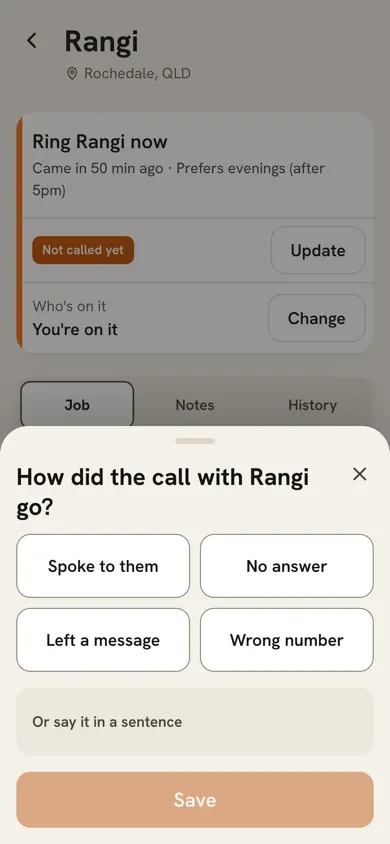
See how the app works
Common questions
How long should a business voicemail be?
Aim for under 20 seconds. That is enough for your name and business, the job, the suburb, one reason to ring back, one time you will try again, and your number twice. Time yourself once and cut words until it fits.
Should I leave a voicemail or hang up and text?
Do both. Leave a short message so they hear a real person, then send a text with the same details straight after. Many people read a text before they play a message.
What should I say in a voicemail to a customer about a quote?
Say who you are, which quote you are ringing about and when you sent it, then offer to go through it or change something on it. Avoid “just following up”. Give one time you will try again.
How many voicemails should I leave a new lead?
Two is usually enough: one on the first try and a shorter one a day or so later. On the other tries, a text after the call does the job without filling their inbox.