
The KPIs worth checking every week in a trade business are leads in, time to first call, leads spoken to, visits, quotes sent, jobs won, dollars won, average job and cost per job won. Keep them on one sheet, fill it in each Friday, and compare each week with your own last eight.
That is nine numbers. Add the money numbers your bookkeeper gives you each month, and you can see where the work comes from, where it stalls and what it costs you.
What a KPI is, for a tradie
A key performance indicator is a number that shows whether the business is heading where you want it to go. Business Queensland describes KPIs as a measured value showing how effective the business is against its key targets, and says to check them as often as the business needs, from daily to yearly.
For a trade business, the useful ones follow a job from the first ring of the phone to money in the bank. The aim is to spot a problem in week two, not in the quarter the cash runs short.
The weekly nine
| Number | How to work it out | What it tells you |
|---|---|---|
| Leads in | Count new enquiries this week, from every source | Whether enough work is coming in |
| Time to first call | Hours from enquiry to your first call, averaged | Whether leads wait too long |
| Spoken to | Leads you actually had a conversation with | How many you reach at all |
| Visits | Site visits or measure-ups done | How many calls turn into a real look |
| Quotes sent | Written quotes out the door | Whether visits turn into quotes |
| Jobs won | Quotes accepted this week | The count of new work |
| Dollars won | Total value of jobs won | The size of new work |
| Average job | Dollars won divided by jobs won | Whether you are winning the jobs you want |
| Cost per job won | Ad spend and lead fees divided by jobs won | What each signed job cost to get |
Dollars won and cost per job won jump around week to week, so read them over a month. Average them across four weeks before you change anything.
Why these and not others
The first six are leading numbers. They move before the money does. If leads in drops this week, the dollars won will drop in a month or two. If time to first call creeps from two hours to two days, fewer leads will be spoken to and fewer visits will follow.
The last three are lagging numbers. They tell you what already happened. You need both. The leading numbers tell you what to fix, and the lagging ones tell you whether the fix worked.
Leave out vanity numbers. Page views, likes and followers do not pay wages unless they show up as leads in.
The monthly money numbers
Once a month, add three numbers from your books:
- Gross margin. Income less the direct cost of doing the jobs (materials, subcontractors, labour on site), as a percentage of income.
- Money owed to you. Invoices sent and not yet paid, and how old they are.
- Cash in the bank against the bills due in the next month.
A busy month with a thin margin and slow payers can leave you worse off than a quiet one. Your accountant or bookkeeper can set these up for you. Ask what they mean for your business, since this is not financial advice.
A sheet you can copy
One row per week. Fill it in each Friday from your phone log, your inbox and your quote folder.
| Week starting | Leads in | Hours to first call | Spoken to | Visits | Quotes sent | Won | $ won | Ad spend and lead fees |
|---|---|---|---|---|---|---|---|---|
| [date] | [ ] | [ ] | [ ] | [ ] | [ ] | [ ] | [ ] | [ ] |
| [date] | [ ] | [ ] | [ ] | [ ] | [ ] | [ ] | [ ] | [ ] |
Average job and cost per job won come from the columns, so you do not need to write them in. Work them out at the end of each month.
The sheet only works if every enquiry is written down when it comes in. For the list behind it, see keeping track of enquiries and quotes.
Reading the numbers
Compare each week with your own last eight. The business.gov.au checklist for growing a business suggests you set measurable targets you can use to track your progress. Your own recent weeks are the fairest place to set them from.
When a number moves, look one step back:
- Fewer won, same quotes. Look at your follow-up and your price.
- Fewer quotes, same visits. Quotes are being left unwritten. Check your week.
- Fewer visits, same leads. Look at the first call and how fast it happens. The timing is in how fast to call a new lead.
- Cost per job won rising. Either spend went up or fewer leads turned into jobs. The steps above tell you which.
Two other figures come straight out of the sheet. One is what a lead is worth to you, worked through in what a lead is worth to your business. The other is what each job costs to win, set out in customer acquisition cost for tradies.
Keeping them without software
A ruled page or a spreadsheet is enough for most owner-operators. Put the sheet where you will see it on a Friday afternoon and give it fifteen minutes.
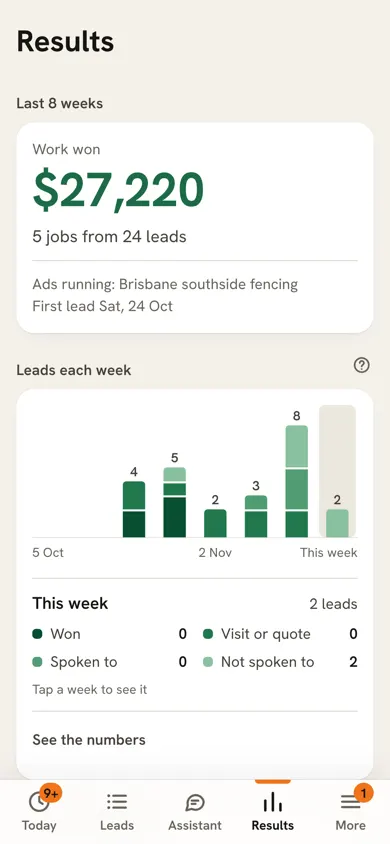
Software earns its place when several people take calls, when you want the counts done as you go, or when you want the numbers on your phone. If you take homeowners through PreBuild, the free PreBuild app keeps most of these for you: it shows work won in dollars, how fast you ring new leads and where jobs drop off.
The trade does not change the list. A renovation business will read dollars won over a quarter, while a fencing business can read it monthly. The nine numbers stay the same.
See how the app works
Common questions
What KPIs should a trade business track?
Each week: leads in, time to first call, leads spoken to, visits, quotes sent, jobs won, dollars won, average job and cost per job won. Each month: gross margin, money owed to you and cash in the bank.
How many KPIs is too many?
If you cannot fill the sheet in fifteen minutes, there are too many. Start with the weekly nine and add one only when you have a question it answers.
Do I need software to track KPIs?
No. A spreadsheet or a ruled page with one row per week does the job. Software helps when several people log calls or you want the counts done for you.
What is a leading and a lagging number?
A leading number, such as leads in or time to first call, moves before the money does. A lagging number, such as dollars won, tells you what already happened. Watch both.
How do I know if my numbers are good?
Compare each week with your own last eight weeks. A trend in your own business is more useful than a figure from someone else’s.