
Part of the HVAC business guide.
The HVAC sales tips that hold up are the plain ones: call no-heat and no-cool inquiries back within minutes, ask questions before you recommend anything, size the system for the house, give two or three written options, answer financing questions directly, and follow up on a date you agreed. Pressure closes a few jobs and costs you the reviews and referrals that bring the next ones.
This article follows a replacement sale from the first call to the follow-up, for an owner or a small team that sells its own work.
The first call: speed first, then three questions
A homeowner with no heat in January or no cooling in July calls whoever answers. Call back within minutes if you possibly can, and give a time. If you cannot get there today, say so, so they can decide what to do.
Replacement inquiries move slower, but the first contractor to have a real conversation still has the edge. Our article on speed to lead for contractors covers what to set as a response standard.
On the call, get three things before you book the visit:
- What is happening. “Tell me what the system is doing.” Let them describe it. It tells you whether this is a repair call, a replacement, or both.
- How old the system is, and what it is. Furnace, heat pump, central air, mini-split. Roughly how old. Any recent repairs.
- Who decides, and when they can both be there. If two people decide on a system worth thousands of dollars, book a time when both can be home.
Before the visit
Send a short text the day before with your name, the time window and a photo of yourself or the truck. Homeowners are letting a stranger into their house. Showing up when you said, or calling if you are late, is part of the sale.
Look up the address so you know the size and age of the home roughly before you arrive. Bring what you need to measure.
The in-home visit: listen, measure, explain
Ask before you look
Start with the homeowner, not the equipment. Which rooms are too hot or too cold? How are the bills? How long do they expect to stay in the house? Is anyone in the house sensitive to dust or humidity? The answers decide what you recommend.
Size it for the house
ENERGY STAR’s page on HVAC quality installation tells homeowners to ask that equipment is sized for their specific home rather than by a rule of thumb, warns that oversized equipment may cycle too often and wear out sooner, and lists airflow, refrigerant charge and duct checks as things to ask about. Some homeowners will have read advice like it. Doing a proper sizing and explaining it is good selling and good work at the same time.
Show what you found
Take photos of the equipment, the data plate, the ductwork and anything wrong. Show them on your phone while you explain. A homeowner who sees the cracked part or the rusted pan understands faster than one who is told.
Options, in writing
Give two or three options, not one take-it-or-leave-it number and not seven. For example:
- Repair what is broken now, if a repair is realistic, with a plain note on the age of the system.
- A standard replacement sized for the house.
- A higher-efficiency replacement, with what it does better and what it costs more.
Put each option in writing with what is included, what is not, the warranty and the price. The FTC’s page on avoiding home improvement scams tells homeowners that a written estimate should include the work, materials, completion date and price, and to ask why if estimates differ a lot. Write yours so that question is already answered.
If you include a repair option, mean it. A homeowner who later learns a repair would have done the job will not refer you.
Financing questions, answered directly
Many homeowners ask about monthly payments for a replacement. If you offer financing, give the lender’s terms in writing and answer what you are asked: the rate, the term, the monthly payment, any promotional period and what happens when it ends. If you do not know, say so and find out.
The same FTC page tells homeowners never to agree to financing through a contractor without shopping around and comparing loan terms. Say it first: “You’re welcome to compare this with your bank.” It costs you nothing with a homeowner who was going to compare anyway, and it tells them you are not hiding anything.
Signing at the kitchen table: know the cooling-off rule
The FTC’s Cooling-Off Rule gives buyers until midnight of the third business day to cancel many sales made at their home, and the seller must tell them about that right and give them cancellation forms. The FTC page lists exceptions, including sales needed to meet an emergency and repair or maintenance the homeowner asked for, though items bought beyond that request are covered. Many states add their own rules for home improvement contracts. Check your state, and have your paperwork reviewed. This is not legal advice.
In practice, a homeowner who feels rushed into a replacement is the one most likely to cancel. Give them time.
Follow-up after the visit
Most replacement estimates are not signed at the visit. Before you leave, agree when you will call: “Can I call you Thursday evening to answer any questions?” Then call Thursday evening.
- Two or three days after: answer questions, confirm the option they are leaning toward.
- A week after: ask whether anything is holding them back.
- Two to three weeks after: a last check. If they chose someone else, ask what decided it.
Our article on the follow-up email after an estimate has wording you can adapt.
What to avoid
- Price-today-only discounts that expire when you walk out the door.
- Scare talk about carbon monoxide or failure that the inspection does not support. If there is a real safety issue, show it and explain it calmly.
- Recommending equipment sized by the old unit’s label without checking the house.
- Talking past the second decision maker.
For the wider business side of an HVAC company, from getting calls to service agreements, see our HVAC business guide. PreBuild runs HVAC leads in the United States, sending each checked homeowner to one contractor only.
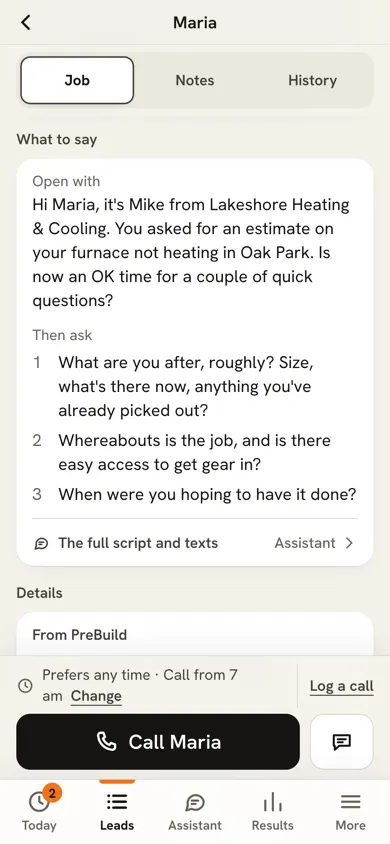
See how the app works
Common questions
How do you sell HVAC without being pushy?
Ask questions before you recommend anything, explain what you found in plain words, give two or three options with prices in writing, and let the homeowner take time to decide. Then follow up on a date you agreed.
Should I give repair and replacement options?
Yes, when a repair is realistic. Show the repair cost next to the replacement cost and explain the age and condition of the system. Homeowners trust a contractor who shows them the cheaper choice too.
Should I offer financing on HVAC replacements?
It can help a homeowner who needs a system now and cannot pay in one go. Give the terms in writing, answer questions directly, and say they are free to compare other loans. The FTC tells homeowners to shop around before agreeing to contractor financing.
Do I need to size the system before I give a price?
You should. ENERGY STAR tells homeowners to ask that the equipment is sized for their home, not by a rule of thumb, because oversized equipment can cycle too often. A sizing done at the visit also gives you something concrete to explain.